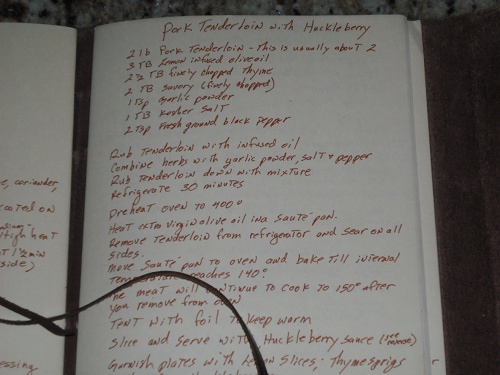
I mentioned that I had something special planned for a few of the Elderberries I picked last week. So I dug out my "super secret squirrel" cookbook and thumbed through the pages until I found what I was looking for. It's been awhile since I have indulged in this sort of dinner time decadence. But it was well worth the wait.
I use this Herb Seared Pork Tenderloin Recipe a lot; alone as well as with several sauces. One of my favorites is a Huckleberry sauce, but I am going to focus on the Elderberries this time. It's a lightly tart yet robust sauce that also works well on Venison too. In fact, it's utterly AWESOME on Venison... Alas, I must make due with Pork Tenderloin, as Venison is a little beyond my reach right now.
To accompany this dish, I would suggest roasted golden beets.
Herb Seared Pork Tenderloin in Elderberry Sauce
Printable Recipe
1 Pork Tenderloin (
approximately 1.25 lbs)
1 TB Dried Lemon Thyme
1 tsp Dried Rosemary
1 tsp Granulated Garlic
1 tsp Kosher Salt
1/2 tsp Black Pepper
Zest of 1 Lemon
Olive oil
Remove the silver-skin from the tenderloin then dry it with a paper towel.
In a small bowl, combine the Lemon Thyme, Rosemary, Granulated Garlic, Salt, Pepper and Lemon Zest; tossing to mix well.
Rub the Pork Tenderloin with Olive oil.
Rub the Tenderloin with the herb mixture.
Wrap in plastic wrap and refrigerate for 30 minutes.
Meanwhile, start the elderberry sauce.
After chilling the tenderloin, begin heating olive oil in an oven proof pan over medium flame and preheat the oven to 400 degrees.
Add the Tenderloin and sear on all sides.
Move the Tenderloin, pan and all, to the oven and roast for 15-20 minutes or until the internal temperature reaches 155 degrees.
Remove from oven and tent with foil for 10 minutes to allow the tenderloin to continue cooking (
it should reach 165).
Slice into medallions with a carving knife and serve with the warm Elderberrry sauce, below.
Elderberry Sauce
1/2 cup Pinot Noir
1 cup Elderberries, divided
2 shallots, minced
1 TB Red Wine Vinegar
1 clove Garlic, minced
6 oz Demi-Glace
1/2 tsp Kosher Salt
1/4 tsp Black Pepper
2 TB Butter
1/2 tsp Lemon Thyme
Place Pinot Noir, 1/2 cup of the Elderberrries, Shallot, Red Wine Vinegar & Garlic in a small sauce pan, simmer over low heat until reduced to 1/4 cup.
Strain sauce, then return to the pan.
Add the Demi-Glace and the remaining 1/2 cup of Elderberries.
Simmer over low heat until reduced to 3/4 cup.
Finish the sauce by whisking in the Butter and the Lemon Thyme.
Serve over sliced tenderloin medallions.
Mangia!!
~~
Oh, in case you were curious....
This is my personal cookbook...
Filled with all sorts of "stuff" and "things" ;)
Stay Hungry!