Showing posts with label Rye Bread. Show all posts

Monday, April 15, 2013

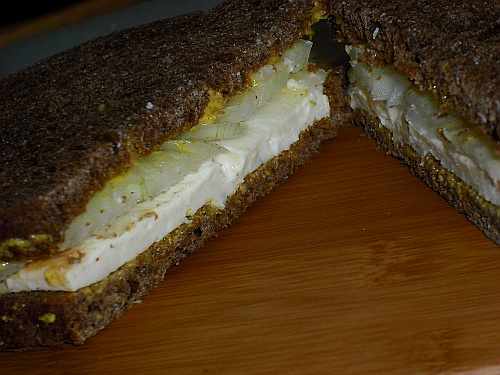
Loathsome Luncheon - The Classic Limburger Sandwich

I released the proverbial feline from the confines of my satchel the other day, in my post on Macaroni with Cauliflower & Taleggio, when I mentioned that I loved cheese with some stank to it.  I was not kidding.  So, I am coming clean about one of my food consumption habits of questionable social acceptance.

I love Limburger Cheese.  I don't get it very often, cause it's difficult to find, so when I DO find it, I relish every last slice.  And no, I don't wear a clothespin on my nose when I eat it.   ;) 

(Image courtesy of Wikipedia)

Limburger use to be extremely popular around the turn of the century.... The other century, not the recent one. (which is technically the turn of the millennium)  My great-grandpa Wes use to eat it at the Round House in The Dalles all the time.  It was so popular back in the 20's that there were multiple manufacturers in the United States producing upwards of 10 million pounds every year; and they could barely keep up with the demand.  Sadly, only the Chalet Co-Op of Monroe Wisconsin remains.  Though they still make over 800,000 lbs of the stuff every year. So somebody, other than myself, is out there eating it too.

First made by Trappist monks in the historical Duchy of Limburg, which now days constitutes parts of the Netherlands, Germany and Belgium, it's name is actually derived from the town of Limburg where is was sold.  This washed rind cheese, similar to real Muenster (American versions are much more mild in flavor) or Appenzeller, enjoys extreme popularity in Germany to this day.  After the curd is formed, it is salted and placed out on pine boards in the aging room.

(Image courtesy of Farm to Table Wisconsin)
Then it is washed down with a bacterial solution of brevibacterium linens. (which is also used in making Raclette, Muenster and Port-du-Salut)  This goes to work on the cheese curd, turning it from a crumbly acidic chunk of something similar to feta, into a soft creamy unctuous block of deliciousness.  Sure is smells.  The bacteria used are the same ones that live on the human body and are partially responsible for body odor, but once you move past the smell, (which really isn't THAT bad) the flavor is so unbelievably mild that it's amazing.

Now I will warn you, that after the cheese reaches 6 months of age, it's a little to pungent for me as well.  My favorite age is between 4 and 5 months.  If you have an issue with the smell, you can greatly reduce the aroma by cutting off the rind as soon as you bring it home, and disposing of it in your outside garbage can.  Then you should be able to simply keep it in a plastic bag in the refrigerator.

Me?  I like the rind, so I do what my Great-Grandma Ruby would have done.

Once I have opened the wrapper, and released the dogs of war, I simply place it in a sealed Mason jar to contain it's odoriferousness and prevent my refrigerator from smelling like the Chalet Co-Op's aging room. 

So how do I eat my Limburger?  I prefer the classic way.  Besides, it gives me an excuse to imbibe a good German Dopplebock.  :)

Classic Limburger Sandwich

Dark Rye Bread
Spicy Brown Mustard
Sweet Onion (be it Maui, Mayan, Vidalia or Walla Walla)
Chalet Limburger Cheese
German DoppleBock

Lay out your slices of Dark Rye Bread (you can use a lighter Rye, but "Dark" Rye or Pumpernickel are the best) and spread with Spicy Brown Mustard.

Lay out slices of Sweet Onion on one side.

Slice the Limburger, as best you can, cause it can be REALLY soft, and lay them on the other side.

Bring both pieces of bread together and there you have it.

The Sweet Onion, spicy Mustard and Limburger on hearty dark bread just play so unbelievably well together.

But they are topped off by a nice dark German beer such as a Dopplebock.

MMMMMMMMMM!

If you will please excuse me, I must return to my Corrupt Canape, my Repugnant Repast, my Fetid Fodder, this most Malodorous of Meals....  Heaven on bread! 

Mangia!!
~~

Sunday, May 8, 2011

Carried Away With Caraway - Polish Buttermilk Rye

I love homemade bread.  Love it!
I just don't normally make it due to the amount of time it takes.  Let's face it, when one is producing bread, one must be in the general vicinity of the dough for the duration.  You mix up a Starter, Mother, Biga or Poolish then that must "ferment". Then you mix up the actual dough and add the Starter, Mother, Biga or Poolish... and that must rise, then you form loaves and THAT must rise... Then you have to bake it.  Time - Time - Time - Time - Time.   (did I mention it takes time?)

On the flip side, there are those easy breads such as Foccacia and Pizza dough.  I make those all the time due to their hands off approach.  You simply activate the yeast in warm water, then simply mix up the dough and toss it in the refrigerator for 8 hours to do it's thing.  Totally hands off, until you are ready to form the pizza crust or loaves.

While I am thinking about it, I would like to put forth a terminology change. This form of raising dough and/or batter, as in the case of Brussels waffles, in the refrigerator is usually referred to as "slow rising", or worse, "retarding the rise".  And while I do enjoy the extra flavor this gives to the dough, I don't really care for the first term and I find the second one particularly offensive to be honest.  Since I have been brewing beer, which involves yeast as well, I would like to point out that any beer in which the yeast is fermenting (breaking down sugars to produce various organic compounds as well a carbon dioxide) under refrigeration temperatures is called "Lagering" (This is where the term "lager" beer comes from) So I propose that raising dough under refrigeration hence forth be referred to as "Lagering the dough"  I just had to put that out there...  OK, back to our regularly scheduled Blog post.

Of all the more complicated breads out there, my ultimate favorite is Rye bread... Be it Russian, Dark, Pumpernickle, Jewish, Polish or any of the other million variations they are all just darned yummy.

Working with Rye is particularly tricky though, because of the grain's makeup.  First off, Rye is low in gluten, which is what really holds bread together and allows it to contain the carbon dioxide thus allowing it to rise.  The second issue is the particular enzymes in the grain which differ from those of wheat.

Warning....   I am about to geek out.....   ;)

There are two basic forms of grain starches.... Amylose and Amylopectin.  You may remember these from my risotto posts.  Shorter grained "risotto rice" such as Arborio & Carnaroli contain higher quantities of Amylopectin which is responsible for the creamy deliciousness that is Risotto.  OK.  Well, all grains have these two starches in different ratios, whether Rice, Wheat, Rye, Triticale or Barley.  Because Rye is lower in gluten (which is a protein, not a starch) the structure of the Rye bread is more dependent on the Amylose starch than on Gluten protein.

Enter the nasty bad evil amylase.  (at least as far as bread is concerned, for beer its a good thing)

Amylase is an enzyme that breaks down a plants starch reserves, similar to the way your body uses lipase to breaks down fat. (remember, plants store food a starches not fats) This enzyme is alive and active in Rye flour as well as Wheat flour.  However, the amylase in wheat is more susceptible to heat and becomes inactive, while the Rye amylase is unaffected and continues breaking down starches during the baking process.  So while you are depending on starches gelling properly for your Rye bread structure the evil amylase is tearing it down and releasing your carbon dioxide, making your bread flat. This is not as big of a deal with Wheat bread, as you have plenty of gluten for support.  But as I said, Rye is low in gluten and what little gluten it DOES have is very weak.

Luckily, there is a solution.  Acid.  For while heat has very little effect on the Amylase in Rye, acid stops it dead in it's tracks.

THUS, most Rye bread starts out as a sourdough containing lactic acid, courtesy of the lactobacillus bacteria that are living symbiotically with the yeast (saccharomyces).  But, you can "cheat".  Hee hee hee hee.  Buttermilk is an excellent way of acidifying your Rye dough and saving you a weeks worth of cultivating a Sourdough starter.  What could be better?  It adds richness to the dough, cause it's milk, and acidifies at the same time, thanks to the lactobacillus bulgaris.  AWESOME!!!! 

So here is my cheaters Buttermilk Rye bread...

Polish Buttermilk Rye Bread

2 1/4 cups (18 oz) (532 ml) Buttermilk (I prefer Bulgarian because it's more sour)
1/4 cup (2 oz) (60 ml) Water
2 TB Unsalted Butter
1 TB Sugar
1 TB Molasses 
1 tsp Kosher Salt
1 package (1/4 oz) (7 g) Active Dry Yeast
4 cups (16 oz) (452 g) Rye flour
2 1/2 cups (13 1/2 oz) (382 g) Bread flour
2 TB Caraway seeds
1 beaten egg white for egg wash

Heat the Buttermilk to 120 degrees....

Remove from the heat and add Butter Molasses, Sugar and Salt, then stir until the butter is completely melted.

Sprinkle the yeast over the top of the somewhat cooled mixture.

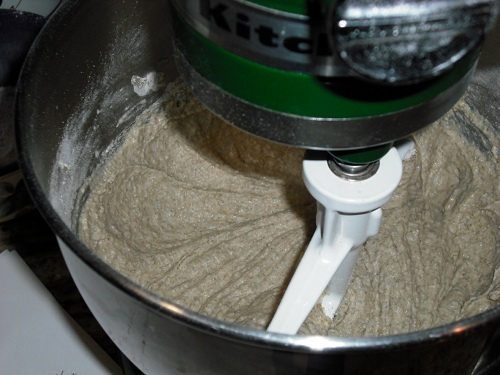
Pour into the work bowl of your mixer that has been fitted with the paddle attachment, then sprinkle 3 cups (12 oz) (340 g) of the Rye Flour over the buttermilk mixture.

Beat until thoroughly combined.

Add the remaining 1 cup (4 oz) (112 g) of Rye flour and continue beating until combined.

Quickly oil a large bowl with either Olive oil or Vegetable oil.

Scrape the Rye "paste" from the mixing bowl and into the oiled bowl.

Cover and set in a warm place to rise, until doubled in volume (about 1 hour)

Clean your mixer bowl and fit the mixer with the dough hook.

When doubled in size, remove the Rye "paste" from it's place of raising and scoop it back into the mixing bowl.


Begin "kneading" with the dough hook while slowly adding 2 cups (11 oz) (312 g) of the bread flour and the 2 TB of Caraway Seeds.

Once it has been incorporated, turn the dough out onto a surface that has been floured with the remaining 1/2 cup (2 1/2 oz) (70 g) of bread flour.

Knead by hand until it has been incorporated as well. (you can technically do this with the mixer, but I like to get my hands in the dough to make sure it feels right)

Divide the dough in 2 pieces of about 1 lb 10 oz (26 oz) (737 g) each.

Form into either rounds or longs and place on a parchment lined baking sheet.

Cover again, with a towel this time, to allow for vapor loss, and let rise for 1 hour.

When there's about 15 minutes left for the rise go ahead and begin preheating the oven to 350 F (175 C) degrees.

When the loaves have finished rising, make 3 slices in the top of each loaf, then brush the tops with beaten egg white.

Place in the oven  and bake for 50 minutes.

Turn loaves out onto a cooling rack, and let cool. (I know it's hard, not to cut into it right away, but you need to let the gelled starches set completely after baking)

Once cooled, slice a big hunk and enjoy.

Can't eat 2 whole loaves before they go stale?  That's alright, you can slice one up, place it in a freezer bag and store in the freezer for up to 3 months.

Mangia!!
~~

Tuesday, March 17, 2009

The Pursuit of Happiness - Perfecting the Reuben

Food Origin: The Reuben Sandwich… this is going to be long.
Debate continues as to the origin of this sandwich. Some swear it was 1916 when Arnold Reuben, owner of Reuben’s Delicatessen in New York served the first Reuben. Others swear it was Reuben Kulakofsky of the Blackstone Hotel in Omaha Nebraska circa 1925. Still others claim it was Fern Snider of the Rose Bowl Restaurant, still in Omaha, in the 1956 National Sandwich Contest. Well, after a lot of reading and digging I have deduced, with my keen senses, the true origin of the Reuben sandwich.

It was Colonel Mustard in the Billiard room with a Candlestick.

Regardless of the WHO, the WHERE, or the WHEN, the Reuben is one of the quintessential sandwiches. This is noticeable by the fact that you can refer to it as “A Reuben” and people know you are talking about a sandwich and not the guy next door. All GREAT sandwiches have experienced this phenomenon, a Monte Cristo, a Grilled Cheese, a Muffaletta, and a BLT, just to name a few. Yes, like all these, the Reuben has taken the world by storm and can be found everywhere. Now that is not to say that all Reubens on the menus of the world are *good* Reubens, just that they exist. But truly great Reubens can sometimes be found in the most unlikely places. After all, one of the best Reubens I have had in my life came from a little “Chinese” deli in Riverside, California. Go figure.

There is yet another mystery regarding the famed Reuben… The Dressing… I was raised with Mayonnaise gracing my rye bread. Thousand Island, which seems to be the accepted norm now days, was not allowed in the house for my mother abhorred all things with hidden sugar, and let’s face it, Thousand Island dressing might as well be dessert it is so sweet. In my research, however, I discovered that the original Reuben was made with Russian dressing…

This presents its own set of issues…. There is NO single recipe for the elusive Russian dressing, from which Thousand Island was derived. Oh yes, there are recipes claiming to be original but they range from Mayonnaise based to Yogurt based to Oil based and back again, containing everything from caviar to chopped boiled eggs and yes, even sweet pickle relish and ketchup. (Thus, the connection of Thousand Island dressing is made.) One thing was abundantly clear though; Russian dressing is spicier than Thousand Island, since it contains Chili sauce or Cayenne pepper, an ingredient that was a standard in almost all the recipes I found.

It was at this point, however, that I realized that I was not going to really be able to produce a Traditional Reuben sandwich at home, since no one seems to know what one *really* is. So I have resigned myself to producing what I THINK is as close as I can get in the modern age…

I decided to tackle this by concentrating first, on the individual ingredients.


Corned Beef...
This year I was privy to the idea of steaming instead of crock-potting it. I decided to experiment after a little internet browsing through the LA times.

Simply place water and the spice packet, if you have one, in the bottom pot. (I used my wok, cause it has this nifty steamer grate… THANKS DAD!!! My dad is the guru of kitchen gadgetry)


Line the steamer basket with cabbage leaves (I use a Napa cabbage)


Place the meat on top with the fat facing up.


Cover and Steam for 50 minutes per lb.


Remove and slice after cooling slightly…. YUM!!!

I snitched some… Tender, Juicy and delicious!!!!!

Ok, the Corned Beef completed!!

Now, Dressing...I had purchased Annie’s Organic Thousand Island dressing as a base… Why? There were four reasons:
  • It contains no High fructose Corn Syrup like all the others (It’s sweetened with good old fashioned sugar)
  • It is based on Yogurt instead of Mayo or just oil, which I feel more closely resembles the Russian Salad dressing.

  • Well… It’s organic, which always makes me feel better, since none of the other stuff is.

  • Finally, it was on sale and actually cheaper than Wishbone, Kraft, Girards or Ken’s Steak house.
So, to my Thousand Island I added some Cayenne pepper (I resisted using Chipotle powder)
Dressing designed……

Cheese...
OK, Swiss is the cheese. There is no doubt about that. But I was being stubborn, if I was going use Swiss cheese, I wanted SWISS cheese… Thus I needed Emmental… The Original, that most U.S. Swiss, as well as the Norwegian Jarlsburg are modeled after.

Cheese chosen.....

Saurkraut….
Being of German, Dane, and Swiss descent; or DaSwiGerm, if you will (The 'w' is pronounced like a 'v'). I know my Kraut… Whether it be Zuurkool, Surkal or Kapusta (which is actually Polish). The point is that I love Sauerkraut; mixed in mashed potatoes, served over knockwurst/bratwurst, eaten directly from the jar with a fork, or on my Reuben. Love it!!! But I am picky…

A little about kraut… Sauerkraut is cabbage that has been lacto-fermented. The same way as cold process pickled cucumbers (Barrel Pickles). This process is performed in 3 phases utilizing the beneficial bacterial beasties (they are small) already contained in the cabbage leaf, lactobacillus being one of them. This family of beneficial bacteria is responsible for producing buttermilk, Sour Cream, Creme Fraiche, Yogurt and changing the 'pH' of most Cheeses. Thusly, sauerkraut should really only contain the following:

Cabbage, Water, and Salt, maybe with caraway seeds and a little sugar for those Bavarians out there.

My choice is usually Bubbies because is contains only those three ingredients.
Sodium Bisulfate, Sodium Benzoate and High Fructose Corn Syrup have no business in sauerkraut. For all the touted health benefits of sauerkraut, I would think the presence of artificial preservatives and HFCS would pretty much cancel those out.

Sauerkraut Selected……..

Bread…
Kimmel Rye bread made with Caraway seeds… This is where I deviated a little, I love Sour Dough, and I found a Sour Dough Rye with Kimmel (Caraway Seeds) so I was good to go!!!

Bread bought....


That's everything... WHEW!! Finally, on with the Sandwich…….


The Reuben

2 sliced Sour Kimmel Rye Bread
Unsalted Butter
Thousand Island Dressing (with added Cayenne) or Russian (if you can find it)
Emmental
Sauerkraut
Corned Beef
2 Skillets (sorry but your gonna need 2)
Sandwich knife (or a bread knife and a butter knife)

Let us begin….

Butter the bread slices on both sides and lay on a little waxed paper.

Slice your cheese fairly thin.

Portion out your Sauerkraut if making more than one sandwich. (this is heat and eat, no waiting)

Heat up both skillets. Please DO NOT use Raw Cast Iron for the corned beef and kraut, it will react and taste funny. I do, however, like to use cast iron for the bread and cheese.

Begin grilling or pan searing the bread in one skillet while heating the corned beef in the other.

When the beef is just about heated through move it to the edges of the skillet and add the kraut in the middle. (My skillet was too small so I removed it and tented it to keep it warm)

Flip your Bread and add cheese to 1 slice, then cover to foster melting.

Heat sauerkraut thoroughly, this will steam off some of the excess juices and dry it out a little so your bread will not become soggy half way through your sandwich.

Remove bread from skillet and apply dressing to the un-cheesed side.

Lay Sauerkraut on the cheese covered slice.

Lay down the Corned Beef next,

then the dressed slice of bread on top.
Press down lightly and slice with your knife on the bias…
Move to a plate and serve immediately with a chilled Harp or Guinness….

Mmmmmmm..... Happiness IS a well made Reuben.... and a Cold beer.
Yeah, the final pictures weren't great, but after smelling this thing cooking, I could not wait, so I only took two in hopes that they would come out, then I began eating with great exhuberance...

Mangia!!!
.