Showing posts with label Maple. Show all posts

Saturday, March 24, 2012

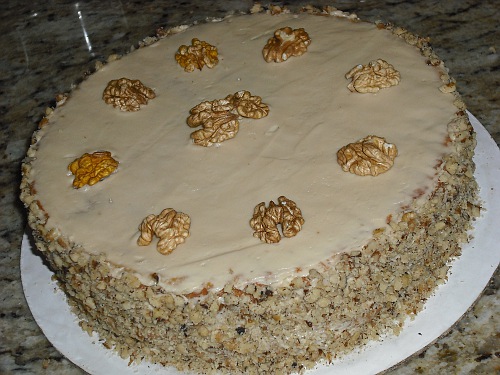
Hungry for Walnuts - Hungarian Walnut Torte

So what do ya do when you have left over Maple Butter-Creme?  Well, since I really didn't want to make a second batch of Macaron, I decided that I would make one of my favorite cakes.

OK, technically it's not a cake, which is a good thing, cause I am really not all that into cake.  It's actually a Torte; and like most tortes, it's made with nuts instead of flour.  Which I guess is why I like them, cause I am kind of nuts myself.  I think of cake primarily as a vehicle by which you get frosting into your mouth.  This is not true of tortes.  They are extremely flavorful and, if the nuts are ground properly and they are baked correctly, they are decadently moist and delicious in and of themselves with no assistance from any frosting.  Thus, as you will see, my frosting layers on this torte are very very thin.

This particular torte manifestation is based on the Hungarian Walnut Torte or "Dios Torta" (Yes, it looks like Spanish instead of Hungarian, but the "s" is pronounced like "sh")

Normally, it would be covered in either Whipped Cream or Coffee flavored Whipped Cream, but as I said, I made just a little TOO much Maple Butter-Creme when I was filling the Macaron.  My excuse? Well, it's really hard to make less than 2 egg whites worth of Italian Butter-creme.  At least I am getting to share this torte now.

Hungarian Walnut Torte

(Dios Torta)

Unsalted Butter, for the pans
1/3 cup (.75 oz) (22g) Panko, finely crushed
10 oz (285g) Walnuts (halves, pieces or any combination there of)
10 large Eggs, separated
6.2 oz (175g) (3/4 cup + 2TB) Granulated Sugar
Maple Butter-Creme, left over from making Macaron ;)

Preheat oven to 350°and crush the Panko with a rolling pin.
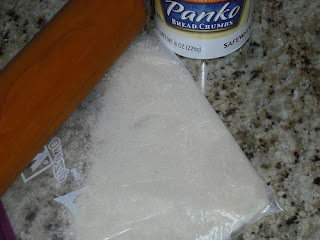
Grease 2 round 9" cake pans with butter,

line bottom of pans with parchment paper, then grease paper in each pan as well.

Coat cake pans with a thin layer of bread crumbs and set pans aside.

Shell your Walnuts, if necessary, and place them in a plastic bag.

Crush them finely with a rolling pin. (do not use a food processor, as you may end up with Walnut butter)

Place the bag of walnut crumbs in the freezer to chill and solidify the oils within the nuts. (you want the nut meal to be fluffy instead of pasty, this is why the food processor is a no-no)
Place Egg Yolks and Sugar into a large mixing bowl and beat with an electric mixer on high speed until they become pale.

Slowly sprinkle the sugar into the bowl and continue beating the yolks until thick and pale yellow, 6–7 minutes.  (this is "ribbon" stage)

Test the yolks by rubbing a small amount between your fingers to ensure the Sugar has dissolved.  If the yolks feel grainy, go ahead an beat them a little longer.

Sprinkle one-third of the ground nuts over yolk mixture and fold them in, just until combined.

Repeat the process twice to use up the remaining ground nuts. (The batter will be very thick)

Set aside.

With a clean whisk, beat egg whites in a medium mixing bowl until stiff peaks form, 2–3 minutes.

Gently stir one-third of the whites into nut mixture.

This will lighten the batter enough to facilitate easier folding of the remaining whites.

Fold the remaining whites into the nut mixture in 2 additions.

Divide batter between prepared pans.

Tap the pans on a flat surface to remove any air bubbles. (you can also stab the batter with a butter knife, just like you do for Angel Food cakes)

Bake until a toothpick inserted in center comes out clean, 30–35 minutes.

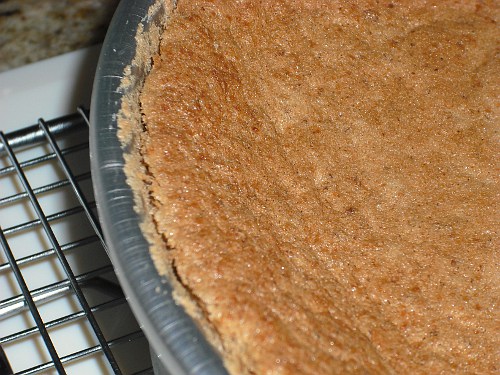
Just until the torte is pulling away from the sides of the pan...

Let tortes cool in pans for 15 minutes, invert onto a wire rack, peel off parchment paper, and let cool completely.

Bring your Maple Butter-Creme to room temperature, if it looks slightly lumpy or separated, simply throw it in the bowl of your mixer and begin beating it in until it becomes smooth and creamy (makes the "slapping" sound)

Once the layers are completely cooled, place one layer on a cake board and apply a VERY thin coat of Maple Butter-Creme.

Place the Second layer on top.

Give the whole torte a very thin crumb coat.

Chill briefly (only about 10 minutes) then apply a second thin coat of Butter-Creme to the top only.

Press Ground Walnuts around the outside of the torte and garnish with Walnut halves.


MMMM It's been so long since I have made a torte, I almost forgot just how much I love them.  Mainly because they are not as sweet as cake....  I will even hazard to say that they are better for you than cake, because even though they DO contain Sugar, they are devoid of the refined flour normally present in cakes.

Mangia!!
~~

Saturday, February 27, 2010

Doughnut and Bacon Lovers Unite!!

This is a Maple Bar.......


This is a Maple Bar from VooDoo Doughnuts.....


Any questions? :)

It has been a long time in coming. After moving back to Portland, I have FINALLY made it back to the BEST doughnut shop on the planet, I just felt the need to share. Especially since I fancy myself to be a connoisseur of all things Bacon. ;)
It's not often that I find a maple bar with REAL Maple glaze instead of that artificial "Mapleine" flavoring stuff that smells like gasoline. (are you listening Krispy Kreme?) Let alone one that has been lovingly graced by a slab of porcine goodness.

Voodoo Doughnuts has been a pumping out treats for residents of Portland for awhile now. Some classic, some not so classic such as this little number I picked up as well.....

A raised doughnut with Chocolate glaze, Rice Krispies and a drizzle of Peanut butter... Awesome!

They even make Vegan doughnuts.... As well as the Official Doughnut of Portland, "The Portland Creme"

So to all my Foodie Friends out there, if you ever visit Portland, be sure to hit Voodoo at either 22 SW 3rd in the Downtown area or 1501 Davis on the East side... You will NOT be disappointed...

And remember, "The Magic is in The Hole", or in the case of my BM (Bacon Maple bar), the magic is in the smoked domesticated boar belly. ;)

Mangia!! But only 1... or your arteries will be screaming for mercy! LOL
~~

Sunday, September 20, 2009

Paul Bunyan's Breakfast Makeover - Mapled Galette Flambé

For those not familiar with the Paul Bunyan myths, he was a ubber garmongous logger dude with a big blue ox named Babe, for a side kick. The point, for the purposes of this post, is that he always ate buckwheat flapjacks for breakfast...

This is my French spin on a logger's breakfast. It's actually my favorite thing to do with buckwheat crêpes. Cause I get to play with fire. Allow me a maniacal laugh.

Muah ha ha ha!

eh, hem.... Thank you... ;)

Lemme tell ya, Paul Bunyan never had it this good! I have never tested it myself, but this may even be a good hangover cure. You know, the "hair of the dog that bit ya". Although in this case, it may be the hair of the ox.

Mapled Galette Flambé
16 Galettes de Sarrasin (Buckwheat Crêpes)
1/2 cup Maple Syrup (grade B has better flavor when mixing with rum)
pinch of salt (yes, believe it or not)
2 TB Water
3 TB Meyers Dark Rum
3 TB Bacardi 151
Lemon Peel to garnish
optional - Broken Pecans or Walnuts

In a large skillet, heat Maple syrup, pinch of Salt, Water and Dark Rum until warm.

Meanwhile, in another skillet, heat crêpe 1 by 1, just until heated through.

Fold into a triangle and arrange carefully in the warm syrup, making sure to dip both sides in the syrup.

Once all the crepes have been added to the syrup, increase the flame and bring the sauce to a gentle simmer for 2 -3 minutes.
Add 151 and as soon as the sauce comes back to a simmer.

Turn off the lights and ignite!!!!

It takes about 20 seconds for the flames to die down... OK, Turn the lights back on, the show's over.

Serve about 3-4 crêpes per person, drizzled with a little of the sauce and garnish simply with Lemon Peel or add some broken pecans or walnuts if you wish.

Mangia!!
~~

Tuesday, April 28, 2009

Sugar..... Aw Honey, Honey - Flex Your Sweet Tooth

One of the key ingredients in almost all baked goods, whether being used for browning purposes, crispness, or it's basic sweet quality, sugar is mysterious ingredient. Derived from multiple sources, Sucrose (what we know as White Sugar) comes in MANY forms, some more refined than others.

Sucrose it primarily derived from Sugar Cane, however, Sugar Beets also provide a fairly high yield of the coveted crystal. Sago and Coconut palms, as well as the "Sugar" Maple and some species of Birch and Pine, can provide sucrose as well. Even honey contains some Sucrose, although it is mostly fructose, making it twice as sweet as table sugar, which is why most recipes call for 1/2 the amount of honey, as they would White Sugar.

I could actually sit here and type all night about the strange properties of sugar, like the fact that it is considered a wet ingredient when baking, due to it's affinity for water and its' humectant properties. (Pulling moisture directly from the air, which is why it clumps if not properly sealed) But I am going to try to get to the main purpose of this post.

Understanding all the different types of Sugar and Sweeteners. This is how I understand the differences, the information presented here is only the basics, and just the tip of the iceberg, as it were. So if you feel the need to add information, please feel free to leave comments and expand upon this information. Thank you.. :)

Powdered/Confectioners' sugar
- Smallest grain usually mixed with cornstarch up to 3% but not lower than 1.5% to keep it from caking. Application: Frostings, Fillings, Glazes, Icings, Mousses.

Super Fine (USA) - Personally, I have only seen the C & H brand in the US. Tiny crystalled sugar, quick dissolving, measures differently than regular granulated sugar (Castor Sugar in Europe; Berry Sugar in Canada) Applications: Meringues, Custards, ButterCreme,

Castor Sugar (EU) - See Superfine; Called caster sugar because the crystals are small enough to fit through the mesh of a "sugar caster"

Berry Sugar (CAN)- See Superfine

Bakers Sugar - Slightly smaller crystal than regular Granulated but measures the same - Dissolves quicker in cold liquids; Easier to use than Super fine because measurements need not be modified; Applications: Meringues, Custards anything where quick dissolving is required.

Granulated Sugar - Regular White Table sugar

Light Brown - Same crystal size as granulated, because is is granulated sugar, but with 3% molasses added back in.  Because of extra moisture, it must be packed down when measuring.

Dark Brown - Same crystal size as granulated, because is is granulated sugar, with 6% molasses added back in.  Like light brown, dark brown contains extra moisture and must be packed down when measuring.

Muscovado sugar - A type of unrefined brown sugar that is dark and sticky due to it's high moisture content.  Unlike most "Brown" sugar, which is originally granulated sugar with molasses added back into it, Muscovado retains it's original molasses content through the minimal processing. One of the "Designer Sugars", comes in light and dark varieties.

Turbinado Sugar - "Designer sugar" - is raw sugar that has been steam cleaned to remove contaminates... Holds more moisture than Granulated sugar, thus has fewer calories... 5 calories less per tsp to be exact, because of the water... Not all Turbinado sugar is created equal.

Barbados Sugar - "Designer Sugar" - Pseudonym for Muscovado, though may be finer grained. A very moist sugar that has been minimally processed retaining it's natural molasses.  If using, recipes need to have the moisture content altered slightly to account for the extra moisture in the sugar.

Demerara sugar another "Designer Sugar" from Guyana is a type of raw sugar - is slightly larger crystal size containing its natural molasses. Applications; Great for crusting desserts such as creme brulee or bread puddings.

"Raw"/"Washed"/Sanding sugars are about the same crystal size - Sanding sugar is usually colored or CAN be colored.

Pearl/Nib sugar - Like small uniform version of lump sugar. About the size of a Cardamom seed. Applications; Folded into Liege Waffle batters and sprinkled on various Scandinavian, Belgian, Dutch and German desserts

Lump sugar - Actual irregular compressed lumps of sucrose sugar, can be white refined, or contain molasses; sometimes known as "Coffee Sugar".  Dates back long before modern "cube" sugar, thus the question... "One lump, or two?"

Cube Sugar - Uniformly cubic lumps of White granulated sucrose sugar

Cone sugar (Panocha or Panela) - an actual cone of "Brown" sugar that has been compressed (You can still fine the mold in antique stores) usually has to be scraped.

As a side note regarding Raw Sugars ----- the Brand "Sugar in the Raw" is not really a raw sugar... It's a name brand of sanding sugar with molasses sprayed on it... The molasses is only on the outside of the crystals. It is created by boiling down, not steamed. I think that C & H "Washed" sugar is the same thing, but I am not sure. I will have to do more research...

The closest to actual RAW sugar, since even those that can technically claim to be raw, are still technically processed in some way shape or form, are products like Sucanat that are evaporated cane juice, leaving all the molasses and trace minerals behind, although even these methods can be suspect as to whether the product is actually RAW or not. These "evaporated" sugars don't really form a cohesive crystal structure and are slightly powdery when crushed, like maple sugar.


Sweetening sources besides Sugar Cane and Sugar Beets:

Date Sugar - is not really sugar as we now it for baking... it is finely ground dried dates and does not dissolve.

Maple Sugar - Sugar from boiling the sap of the sugar maple tree - it's about 90% Sucrose mixed with glucose & fructose... Slightly sweeter than Cane or Beet sugar due to the Fructose content.

Birch Syrup/Pine Syrup - More rare as the yield is much lower than the sugar maple, the Sucrose/Glucose/Fructose mixture is similar to that of Maple syrup.

Corn Syrup - Derived from Corn, primarily glucose with a few other sugars.
Applications; Candy making as it helps control the crystallization of Sucrose. Available in Dark and Light as well as the newer "brown Sugar" flavor.

This is unnaturally modified in a dual GMO enzyme process to create ....

High Fructose Corn Syrup -
The Bane of the American People as it is hidden in just about every item of processed food; contains more calories than Cane Sugar. OK, I am about to get a little opinionated.... Just a warning... HFCS is used in processed foods because it is a cheap sweetener, the reason it is "cheap" is that Cane sugar is expensive by comparison, the reason Cane sugar is expensive is because of Corn Lobbyist have succeeded in preventing the Import Tariffs on Foreign Cane Sugar from being lifted and that artificially inflates the cost. Thus the US's Cane sugar comes ONLY from Hawaii. Sugar Beets, however are grown in other states.
OK, I am done ranting now.... ;) Moving on ...

Palm Sugar - Similar to maple Sugar in process, it is produced from both Sago and Coconut palms; Jaggery is a type of Palm sugar from India as is Java Sugar (also in cake form)

Baker's Malt - 1/3rd the sweetness of granulated cane sugar. Produced from the "Malting" or sprouting and then kiln heating of barley (Just like beer, whiskey and malt vinegar) ... most people are familiar with "Malted Milk" which is a combination of Malt, wheat and milk powder, see also Ovaltine and Horlicks

Crystalline Fructose Sugar
- A Simple Sugar usually available in health food stores and natural markets. Although there is now debate on whether consumption of this type of sugar is really healthy. Unlike Sucrose sugar which is a disaccharide (2 simple sugars stuck together, one being fructose the other is Glucose), fructose being a simple sugar, thus it does not need to be broken down, and is processed by the liver. When used in baking, substitute half the amount as you would granulated since it is twice as sweet as Cane sugar.

Honey is high in fructose, this is why most honey recipes use half the amount that you would if using granulated sugar.

Updated - 07/12/10 - I left a couple of sweeteners out......

Agave Nectar - This has become extremely popular as it has a low glycemic index, thus can be consumed by diabetics without fear of blood sugar spikes.  It has also become favored by Vegans as it is produced without bone char as is most white sugars (yes, they use bone char in both beet and cane sugar processing - Unless it's evaporated cane juice)  Agave nectar is produced by boiling down the sap of the Agave plant.  Don't worry, it's a different species of Agave, there will still be plenty of Blue Agave for making tequila.  :)


Golden Syrup - Lyle's is the only brand I have ever seen in the U.S. as this is primarily a British product.  Golden syrup is a pale version of Treacle.  This is a form of inverted sugar. Inverted sugar is created by adding an enzyme (invertase) to a cane sugar/water solution in the presence of an acid... say lemon juice.  The enzyme breaks the Glucose-Fructose bond, so you end up with a syrup that has free glucose and free fructose.  Golden syrup differs from High-Fructose corn syrup in that the process ends with the breaking of the glucose/fructose bond. HFCS undergoes and extra enzymatic step that actually changes some of the glucose into fructose using Xylose Isomerase.  Golden syrup IS sweeter than regular granulated sugar even though it's made from cane juice....  this is due to the free fructose, making it similar to honey both in texture and sweetening power.  It is often used as a substitute by persons who abstain from honey.

I hope that sheds a little light on the scintillating world of sweeteners.

I think I need to go brush my teeth now....
~~