
Showing posts with label Corned Beef. Show all posts
Showing posts with label Corned Beef. Show all posts
Wednesday, March 21, 2012

Monday, March 12, 2012
Old English in the Modern Age - Corning Your Own Beef
I figured since St. Patty's day was fairly close, being Saturday, that I would share my recipe for, what has become, the quintessential food of all American St. Patrick's Day celebrations.... Corned Beef.
So WHY is it called "corned" beef when it contains no corn? Well it seems that, back in the day, salt didn't exist in the refined form we know today as "Table salt". It was much more of a rough product back in the days of yore. The particular unrefined salt used for brining (corning) came in chunks about the size of a corn. I don't mean the size of Corn corn, I am referring to the size of a "Barley Corn". Is this confusing yet? :) You see, the old English word for any type of hard particle or grain seed was "Corn" in much the same way we use the blanket term "Grain" now days. Think of grains of wheat and grains of sand as being wheat corns, corns of sand or, in this case, corns of salt.
Maize from America was originally named "Indian Corn" but this was eventually shortened to "Corn" as Old English became Modern English, and terms like Barley corn, Wheat corn and Rye corn sort of fell to the wayside. Unless you are singing about John Barleycorn while consuming large quantities of beer. But that is another post.
We don't purchase our salt "chunky style" these days, but good old Kosher Salt will work just fine. It's OK, you can still refer to the process as "Corning beef" and the end product as "Corned Beef". I don't think the Old English police will arrest you for using the wrong salt.
The secret to good home corning of beef is to make sure that 1) your brine is really cold, and 2) making sure you "Swiss" the brisket really well with a meat fork or one of those tenderizer gadgets with the rows of little blades or pins so the brisket has more surface area to make contact with the brine.
With those two things in mind, Corning Beef is really very simple. True, the ingredient list is fairly long, due to the spices, but the process of making the brine is very easy. The hardest part is waiting 5-10 days before steaming/boiling it up and consuming it. I prefer to wait the full 10 days, but I am getting a late start this year... So I am only going to get 6 days in before it must be cooked. Once you have corned your beef (at 10 days), you can continue to store it in the refrigerator in the zipper bag for up to 1 week, but no longer than that.
The reason for this is that this particular recipe lacks Potassium Nitrate (Niter, Salt Peter, Pink Salt). I do not feel comfortable adding potentially cancer causing chemicals to my food, so it will not keep as long as one you buy from the store. I am OK with that, since I plan on eating it immediately (and I usually do) after the curing is completed. If you want your corned beef to last longer, go ahead and add about 1 1/2 - 2 TB Pink Salt (Potassium Nitrate) to the brine. Your brisket will be "pinker" than mine and will last a little longer in the brine.
 2 quarts (1.9 liters) Water
1 cup (170g)(6 oz) Kosher Salt
1/2 cup (115g)(4.1oz) Dark Brown Sugar
1 TB Black Peppercorns (See, we still call them "corns")
2 tsp Mustard Seed
2 tsp Coriander Seed
1 tsp Red Pepper Flake
1 Cinnamon Stick, broken
10 All-Spice Berries
8 Juniper Berries
8 Clove Buds
2 -3 Bay leaves (I used three cause mine were pretty small)
1/2 tsp ground Ginger
3 cloves Garlic
2 lbs (910g) Ice (1 quart of water, frozen into ice cubes)
1 sprig of Thyme
5 lbs of Beef Brisket (I chose a point cut instead of the flat end)
1-2 gallon zipper bag
A large stainless bowl, to prevent leaks in the refrigerator
Combine Water, Salt and Sugar in a large saucepan.
 Bring to a simmer and add Peppercorns, Mustard seed, Coriander seed, Pepper Flake, Cinnamon, All-Spice, Juniper, Clove, Bay and Ginger.
 Bring back to a simmer, then add the Garlic cloves.
 Simmer for an additional 5 minutes.
 While the brine is simmering, fill a large pot with the Ice.
 When the brine has finished simmering, move from the stove top and pour the brine over the ice.
 Stir until the ice melts and cools the brine to about room temperature.
 Place in the refrigerator or freezer for at least 1 hour. (You need the Brine to be at 40 F (4 C) degrees)
When the brine is completely chilled, remove the Brisket from the refrigerator and stab it all over with a meat fork to allow the brine to penetrate.

 Place the slab o' meat in a 2 gallon zipper bag.
 Place the Zipper bag in a stainless steel bowl.
 Pour the cold brine over the meat and add the sprig of Thyme.
 Close the bag, removing as much air as possible, and move the whole kit and kaboodle to the refrigerator and let it hang out for at least 5 days, preferably 10.
 Agitate the meat and the brine at least once every day to ensure the brine doesn't separate and that the spices don't set on 1 section of the meat through the entire corning process.
And there you have it.... 15 minutes of work combined with lots and lots of waiting.....
See, I told you it was pretty easy.
Mangia!! (in 5-10 days)
~~
So WHY is it called "corned" beef when it contains no corn? Well it seems that, back in the day, salt didn't exist in the refined form we know today as "Table salt". It was much more of a rough product back in the days of yore. The particular unrefined salt used for brining (corning) came in chunks about the size of a corn. I don't mean the size of Corn corn, I am referring to the size of a "Barley Corn". Is this confusing yet? :) You see, the old English word for any type of hard particle or grain seed was "Corn" in much the same way we use the blanket term "Grain" now days. Think of grains of wheat and grains of sand as being wheat corns, corns of sand or, in this case, corns of salt.
Maize from America was originally named "Indian Corn" but this was eventually shortened to "Corn" as Old English became Modern English, and terms like Barley corn, Wheat corn and Rye corn sort of fell to the wayside. Unless you are singing about John Barleycorn while consuming large quantities of beer. But that is another post.
We don't purchase our salt "chunky style" these days, but good old Kosher Salt will work just fine. It's OK, you can still refer to the process as "Corning beef" and the end product as "Corned Beef". I don't think the Old English police will arrest you for using the wrong salt.
The secret to good home corning of beef is to make sure that 1) your brine is really cold, and 2) making sure you "Swiss" the brisket really well with a meat fork or one of those tenderizer gadgets with the rows of little blades or pins so the brisket has more surface area to make contact with the brine.
With those two things in mind, Corning Beef is really very simple. True, the ingredient list is fairly long, due to the spices, but the process of making the brine is very easy. The hardest part is waiting 5-10 days before steaming/boiling it up and consuming it. I prefer to wait the full 10 days, but I am getting a late start this year... So I am only going to get 6 days in before it must be cooked. Once you have corned your beef (at 10 days), you can continue to store it in the refrigerator in the zipper bag for up to 1 week, but no longer than that.
The reason for this is that this particular recipe lacks Potassium Nitrate (Niter, Salt Peter, Pink Salt). I do not feel comfortable adding potentially cancer causing chemicals to my food, so it will not keep as long as one you buy from the store. I am OK with that, since I plan on eating it immediately (and I usually do) after the curing is completed. If you want your corned beef to last longer, go ahead and add about 1 1/2 - 2 TB Pink Salt (Potassium Nitrate) to the brine. Your brisket will be "pinker" than mine and will last a little longer in the brine.
Corned Beef

1 cup (170g)(6 oz) Kosher Salt
1/2 cup (115g)(4.1oz) Dark Brown Sugar
1 TB Black Peppercorns (See, we still call them "corns")
2 tsp Mustard Seed
2 tsp Coriander Seed
1 tsp Red Pepper Flake
1 Cinnamon Stick, broken
10 All-Spice Berries
8 Juniper Berries
8 Clove Buds
2 -3 Bay leaves (I used three cause mine were pretty small)
1/2 tsp ground Ginger
3 cloves Garlic
2 lbs (910g) Ice (1 quart of water, frozen into ice cubes)
1 sprig of Thyme
5 lbs of Beef Brisket (I chose a point cut instead of the flat end)
1-2 gallon zipper bag
A large stainless bowl, to prevent leaks in the refrigerator
Combine Water, Salt and Sugar in a large saucepan.


When the brine is completely chilled, remove the Brisket from the refrigerator and stab it all over with a meat fork to allow the brine to penetrate.


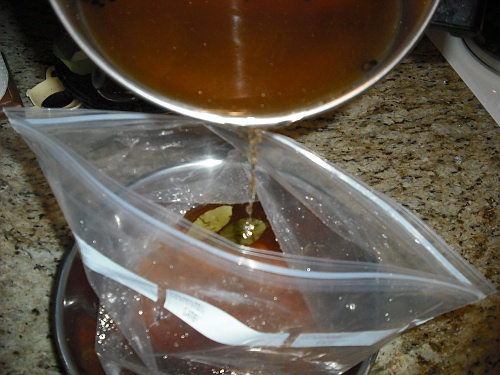

And there you have it.... 15 minutes of work combined with lots and lots of waiting.....
See, I told you it was pretty easy.
Mangia!! (in 5-10 days)
~~
Wednesday, April 15, 2009
It's Always Beddar with Cheddar - Corn Beef Pinwheels
The weather has turned in San Diego, from sunny 75 degrees to cloudy windy chill for some strange reason. When this happens, I usually crave foods from my childhood. I grew up on a goat dairy in the “wilds” of Oregon in east Multnomah County. For those not familiar with Multnomah County in Oregon, it is situated at the mouth of the Columbia River Gorge, bordering Washington. It’s one of the most beautiful places in the world but man! I have mentioned it before in a previous post, the winters can be BRUTAL. Corbett is located at the eastern edge of the county, which is technically still in the gorge, on top of the basalt cliffs. Frequent ice storms accompanied by winds that shriek like banshees are the norm. Yeap, just another winter day. This can make traveling to the grocery store a little bit of a challenge for those without ice skates.
Luckily, my mom had a GREAT recipe for those iced in days, and simply raided the pantry for a couple cans of Corned Beef hash, that she always had on hand for just such an emergency and utilizing her delicious buttermilk biscuit dough. This is the same Buttermilk biscuit dough that I used for Biscuits and Gravy a while back.
The Pièce de résistance, however, was the cheese sauce that she always made to top the pinwheels. Thus without even knowing it, I was exposed to Classic French cuisine. She always started with a béchamel and added her dry mustard powder and cheese, making a Mornay. She never called it that, but since I grew up with it, I assumed it was how all cheese sauce was made.
This led to a horrific dining experience when I ordered cheese sauce. I was fully expecting a cheesy Béchamel, but receiving an oily glop of separated processed cheese YUCK!!
Suffice it to say, Béchamel is one of my favorite sauces as far as versatility. You can add just about anything to it… Make Lasagna sauce by adding double the amount of tomato sauce to it. (1 cup béchamel - 2 cups tomato sauce) Simply pour it on top of Pastitsio or Moussaka as is, or add prepared Mustard or chopped Mushrooms and Tarragon to make homemade green bean casserole sans Campbell's. Then there is the hybrid of Béchamel & Velouté that I like to call belouté or véchamel which is EXCELLENT with savory crepe dishes. (Velouté is a Béchamel made with “white” stock instead of milk… the name comes from the root velour or “velvet”, which is how it feels on the tongue)
OK, I need to reel it in, cause I am about to tangent. Mornay is, classically, made of a béchamel in combination with Parmegiano-Reggiano and Gruyere, but Emmenthal can be used as well as Cheddar. For this recipe, if you are feeling a little more Reuben-esque, then by all means, change out the Cheddar for Emmenthal. I am just in a white cheddar mood tonight. (Ya know? I still have not figured out why so much cheddar, on the west coast, is dyed orange with annatto seed) As a side note, Cheddar Mornay is phenomenal over lightly steamed Cauliflower.
Oh, and if you don’t have buttermilk on hand, you can always make a batch of Jiffy or Bisquick biscuits; I promise not to look ;)

For Pinwheels
3 1/2 – 3 3/4 Cups AP Flour – Plus about 1/4 cup for rolling
1 tsp Baking Soda
2 tsp Salt
2 tsp Baking Powder (Rumford’s – it’s Double Acting AND Aluminum Free)
1/2 cup Unsalted Butter, melted
1 1/2 cup Buttermilk
2 Cans of Corned Beef Hash
1/2 tsp Black Pepper
Mornay (Chedder Cheese Béchamel)
3 TB Butter (1 1/2 oz)
~1/4 cup AP-Flour (1 1/2 oz) It's better if you weigh it
1/2 tsp Dry Powdered Mustard
1/4 tsp White pepper
pinch of nutmeg
2 cup Whole Milk (Hot)
1 cup (4 oz) Extra Sharp Cheddar Cheese (Grated)
2 TB Grated Parmegiano-Reggiano
2 dashes Worcestershire
At least 1/4 tsp Salt but more "to taste" if necessary
Preheat oven to 450
In a large bowl, whisk 3 1/2 cups Flour, Baking Soda, Salt, and Baking Powder.
 In a small bowl, mix the melted Butter and the Buttermilk.
 Pour Butter/Buttermilk into the flour mixture and stir until sticky dough is formed.
 If dough is TOO sticky, add another 1/4 cup of the flour and knead in quickly.
Divide the dough in two pieces.
 Turn out 1 piece onto a board floured with about 2 TB of the remaining flour.
Roll out biscuit dough into a 12x8 rectangle.
 Spread 1 can of hash evenly over the dough, leaving about 1/2 inch on the far short edge to seal when done.
 Sprinkle with pepper and roll up the dough as you would for a cinnamon roll.
 Pinch the end to seal, then slice into 8 spirals.
 Place in a 9 inch cake pan and set aside.
 Repeat with remaining dough ball.
Bake both pans for 30 minutes.
 Meanwhile, make the Mornay
Begin heating milk in a small saucepan about 5 minutes before starting the roux.
 In a medium saucepan melt the butter over low heat, let it bubble a little bit to remove some of the water.
 Add flour and cook, whisking, over low heat until the roux becomes smooth and bubbly. (It will start off lumpy looking, just keep whisking)
 Remove pan from heat and whisk in Mustard, Pepper and Nutmeg.
 Begin adding the scalded milk while whisking constantly.
Return the pan to the heat and bring just to a boil while stirring constantly, sauce will be thick.
Add grated cheeses a little at a time, whisking until melted before adding the more.
 When all the cheese has been incorporated, hit it with a dash of Worcestershire.
 Remove from heat and pour over your pinwheels.
Mangia!!!
~~
The Pièce de résistance, however, was the cheese sauce that she always made to top the pinwheels. Thus without even knowing it, I was exposed to Classic French cuisine. She always started with a béchamel and added her dry mustard powder and cheese, making a Mornay. She never called it that, but since I grew up with it, I assumed it was how all cheese sauce was made.
This led to a horrific dining experience when I ordered cheese sauce. I was fully expecting a cheesy Béchamel, but receiving an oily glop of separated processed cheese YUCK!!
Suffice it to say, Béchamel is one of my favorite sauces as far as versatility. You can add just about anything to it… Make Lasagna sauce by adding double the amount of tomato sauce to it. (1 cup béchamel - 2 cups tomato sauce) Simply pour it on top of Pastitsio or Moussaka as is, or add prepared Mustard or chopped Mushrooms and Tarragon to make homemade green bean casserole sans Campbell's. Then there is the hybrid of Béchamel & Velouté that I like to call belouté or véchamel which is EXCELLENT with savory crepe dishes. (Velouté is a Béchamel made with “white” stock instead of milk… the name comes from the root velour or “velvet”, which is how it feels on the tongue)
OK, I need to reel it in, cause I am about to tangent. Mornay is, classically, made of a béchamel in combination with Parmegiano-Reggiano and Gruyere, but Emmenthal can be used as well as Cheddar. For this recipe, if you are feeling a little more Reuben-esque, then by all means, change out the Cheddar for Emmenthal. I am just in a white cheddar mood tonight. (Ya know? I still have not figured out why so much cheddar, on the west coast, is dyed orange with annatto seed) As a side note, Cheddar Mornay is phenomenal over lightly steamed Cauliflower.
Oh, and if you don’t have buttermilk on hand, you can always make a batch of Jiffy or Bisquick biscuits; I promise not to look ;)
Corned Beef Pinwheels in Cheddar Mornay

For Pinwheels
3 1/2 – 3 3/4 Cups AP Flour – Plus about 1/4 cup for rolling
1 tsp Baking Soda
2 tsp Salt
2 tsp Baking Powder (Rumford’s – it’s Double Acting AND Aluminum Free)
1/2 cup Unsalted Butter, melted
1 1/2 cup Buttermilk
2 Cans of Corned Beef Hash
1/2 tsp Black Pepper
Mornay (Chedder Cheese Béchamel)
3 TB Butter (1 1/2 oz)
~1/4 cup AP-Flour (1 1/2 oz) It's better if you weigh it
1/2 tsp Dry Powdered Mustard
1/4 tsp White pepper
pinch of nutmeg
2 cup Whole Milk (Hot)
1 cup (4 oz) Extra Sharp Cheddar Cheese (Grated)
2 TB Grated Parmegiano-Reggiano
2 dashes Worcestershire
At least 1/4 tsp Salt but more "to taste" if necessary
Preheat oven to 450
In a large bowl, whisk 3 1/2 cups Flour, Baking Soda, Salt, and Baking Powder.
 In a small bowl, mix the melted Butter and the Buttermilk.
 Pour Butter/Buttermilk into the flour mixture and stir until sticky dough is formed.
 If dough is TOO sticky, add another 1/4 cup of the flour and knead in quickly.
Divide the dough in two pieces.
 Turn out 1 piece onto a board floured with about 2 TB of the remaining flour.
Roll out biscuit dough into a 12x8 rectangle.
 Spread 1 can of hash evenly over the dough, leaving about 1/2 inch on the far short edge to seal when done.
 Sprinkle with pepper and roll up the dough as you would for a cinnamon roll.
 Pinch the end to seal, then slice into 8 spirals.
 Place in a 9 inch cake pan and set aside.
 Repeat with remaining dough ball.
Bake both pans for 30 minutes.
 Meanwhile, make the Mornay
Begin heating milk in a small saucepan about 5 minutes before starting the roux.
 In a medium saucepan melt the butter over low heat, let it bubble a little bit to remove some of the water.
 Add flour and cook, whisking, over low heat until the roux becomes smooth and bubbly. (It will start off lumpy looking, just keep whisking)
 Remove pan from heat and whisk in Mustard, Pepper and Nutmeg.
 Begin adding the scalded milk while whisking constantly.
Return the pan to the heat and bring just to a boil while stirring constantly, sauce will be thick.
Add grated cheeses a little at a time, whisking until melted before adding the more.
 When all the cheese has been incorporated, hit it with a dash of Worcestershire.
 Remove from heat and pour over your pinwheels.
Mangia!!!
~~
Tuesday, March 17, 2009
The Pursuit of Happiness - Perfecting the Reuben
Food Origin: The Reuben Sandwich… this is going to be long.
Debate continues as to the origin of this sandwich. Some swear it was 1916 when Arnold Reuben, owner of Reuben’s Delicatessen in New York served the first Reuben. Others swear it was Reuben Kulakofsky of the Blackstone Hotel in Omaha Nebraska circa 1925. Still others claim it was Fern Snider of the Rose Bowl Restaurant, still in Omaha, in the 1956 National Sandwich Contest. Well, after a lot of reading and digging I have deduced, with my keen senses, the true origin of the Reuben sandwich.
Regardless of the WHO, the WHERE, or the WHEN, the Reuben is one of the quintessential sandwiches. This is noticeable by the fact that you can refer to it as “A Reuben” and people know you are talking about a sandwich and not the guy next door. All GREAT sandwiches have experienced this phenomenon, a Monte Cristo, a Grilled Cheese, a Muffaletta, and a BLT, just to name a few. Yes, like all these, the Reuben has taken the world by storm and can be found everywhere. Now that is not to say that all Reubens on the menus of the world are *good* Reubens, just that they exist. But truly great Reubens can sometimes be found in the most unlikely places. After all, one of the best Reubens I have had in my life came from a little “Chinese” deli in Riverside, California. Go figure.
It was at this point, however, that I realized that I was not going to really be able to produce a Traditional Reuben sandwich at home, since no one seems to know what one *really* is. So I have resigned myself to producing what I THINK is as close as I can get in the modern age…
I decided to tackle this by concentrating first, on the individual ingredients.

Line the steamer basket with cabbage leaves (I use a Napa cabbage)

Place the meat on top with the fat facing up.

Cover and Steam for 50 minutes per lb.
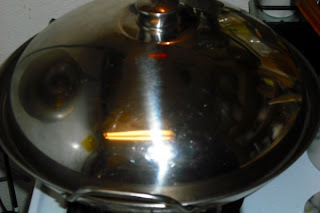
Remove and slice after cooling slightly…. YUM!!!
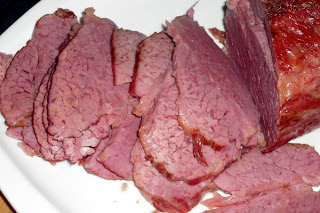 I snitched some… Tender, Juicy and delicious!!!!!
Ok, the Corned Beef completed!!
Now, Dressing...I had purchased Annie’s Organic Thousand Island dressing as a base… Why? There were four reasons:
 Dressing designed……
A little about kraut… Sauerkraut is cabbage that has been lacto-fermented. The same way as cold process pickled cucumbers (Barrel Pickles). This process is performed in 3 phases utilizing the beneficial bacterial beasties (they are small) already contained in the cabbage leaf, lactobacillus being one of them. This family of beneficial bacteria is responsible for producing buttermilk, Sour Cream, Creme Fraiche, Yogurt and changing the 'pH' of most Cheeses. Thusly, sauerkraut should really only contain the following:

That's everything... WHEW!! Finally, on with the Sandwich…….

2 sliced Sour Kimmel Rye Bread
Let us begin….
 Slice your cheese fairly thin.
 Portion out your Sauerkraut if making more than one sandwich. (this is heat and eat, no waiting)
 Heat up both skillets. Please DO NOT use Raw Cast Iron for the corned beef and kraut, it will react and taste funny. I do, however, like to use cast iron for the bread and cheese.
Begin grilling or pan searing the bread in one skillet while heating the corned beef in the other.
 When the beef is just about heated through move it to the edges of the skillet and add the kraut in the middle. (My skillet was too small so I removed it and tented it to keep it warm)
 Flip your Bread and add cheese to 1 slice, then cover to foster melting.
 Heat sauerkraut thoroughly, this will steam off some of the excess juices and dry it out a little so your bread will not become soggy half way through your sandwich.
 Remove bread from skillet and apply dressing to the un-cheesed side.
 Lay Sauerkraut on the cheese covered slice.
 Lay down the Corned Beef next,
 then the dressed slice of bread on top.
 Mmmmmmm..... Happiness IS a well made Reuben.... and a Cold beer.
Yeah, the final pictures weren't great, but after smelling this thing cooking, I could not wait, so I only took two in hopes that they would come out, then I began eating with great exhuberance...
Mangia!!!
.
Debate continues as to the origin of this sandwich. Some swear it was 1916 when Arnold Reuben, owner of Reuben’s Delicatessen in New York served the first Reuben. Others swear it was Reuben Kulakofsky of the Blackstone Hotel in Omaha Nebraska circa 1925. Still others claim it was Fern Snider of the Rose Bowl Restaurant, still in Omaha, in the 1956 National Sandwich Contest. Well, after a lot of reading and digging I have deduced, with my keen senses, the true origin of the Reuben sandwich.
It was Colonel Mustard in the Billiard room with a Candlestick.
There is yet another mystery regarding the famed Reuben… The Dressing… I was raised with Mayonnaise gracing my rye bread. Thousand Island, which seems to be the accepted norm now days, was not allowed in the house for my mother abhorred all things with hidden sugar, and let’s face it, Thousand Island dressing might as well be dessert it is so sweet. In my research, however, I discovered that the original Reuben was made with Russian dressing…
This presents its own set of issues…. There is NO single recipe for the elusive Russian dressing, from which Thousand Island was derived. Oh yes, there are recipes claiming to be original but they range from Mayonnaise based to Yogurt based to Oil based and back again, containing everything from caviar to chopped boiled eggs and yes, even sweet pickle relish and ketchup. (Thus, the connection of Thousand Island dressing is made.) One thing was abundantly clear though; Russian dressing is spicier than Thousand Island, since it contains Chili sauce or Cayenne pepper, an ingredient that was a standard in almost all the recipes I found.
It was at this point, however, that I realized that I was not going to really be able to produce a Traditional Reuben sandwich at home, since no one seems to know what one *really* is. So I have resigned myself to producing what I THINK is as close as I can get in the modern age…
I decided to tackle this by concentrating first, on the individual ingredients.
Corned Beef...
This year I was privy to the idea of steaming instead of crock-potting it. I decided to experiment after a little internet browsing through the LA times.
This year I was privy to the idea of steaming instead of crock-potting it. I decided to experiment after a little internet browsing through the LA times.
Simply place water and the spice packet, if you have one, in the bottom pot. (I used my wok, cause it has this nifty steamer grate… THANKS DAD!!! My dad is the guru of kitchen gadgetry)


 I snitched some… Tender, Juicy and delicious!!!!!
Now, Dressing...I had purchased Annie’s Organic Thousand Island dressing as a base… Why? There were four reasons:
- It contains no High fructose Corn Syrup like all the others (It’s sweetened with good old fashioned sugar)
- It is based on Yogurt instead of Mayo or just oil, which I feel more closely resembles the Russian Salad dressing.
- Well… It’s organic, which always makes me feel better, since none of the other stuff is.
- Finally, it was on sale and actually cheaper than Wishbone, Kraft, Girards or Ken’s Steak house.
 Dressing designed……
Cheese...
OK, Swiss is the cheese. There is no doubt about that. But I was being stubborn, if I was going use Swiss cheese, I wanted SWISS cheese… Thus I needed Emmental… The Original, that most U.S. Swiss, as well as the Norwegian Jarlsburg are modeled after.
Cheese chosen.....
Saurkraut….
Being of German, Dane, and Swiss descent; or DaSwiGerm, if you will (The 'w' is pronounced like a 'v'). I know my Kraut… Whether it be Zuurkool, Surkal or Kapusta (which is actually Polish). The point is that I love Sauerkraut; mixed in mashed potatoes, served over knockwurst/bratwurst, eaten directly from the jar with a fork, or on my Reuben. Love it!!! But I am picky…
Cabbage, Water, and Salt, maybe with caraway seeds and a little sugar for those Bavarians out there.
My choice is usually Bubbies because is contains only those three ingredients.
Sodium Bisulfate, Sodium Benzoate and High Fructose Corn Syrup have no business in sauerkraut. For all the touted health benefits of sauerkraut, I would think the presence of artificial preservatives and HFCS would pretty much cancel those out.
Sauerkraut Selected……..
Bread…
Kimmel Rye bread made with Caraway seeds… This is where I deviated a little, I love Sour Dough, and I found a Sour Dough Rye with Kimmel (Caraway Seeds) so I was good to go!!!
Kimmel Rye bread made with Caraway seeds… This is where I deviated a little, I love Sour Dough, and I found a Sour Dough Rye with Kimmel (Caraway Seeds) so I was good to go!!!
Bread bought....

The Reuben
Unsalted Butter
Thousand Island Dressing (with added Cayenne) or Russian (if you can find it)
Emmental
Sauerkraut
Corned Beef
2 Skillets (sorry but your gonna need 2)
Sandwich knife (or a bread knife and a butter knife)
Butter the bread slices on both sides and lay on a little waxed paper.
 Slice your cheese fairly thin.
 Portion out your Sauerkraut if making more than one sandwich. (this is heat and eat, no waiting)
 Heat up both skillets. Please DO NOT use Raw Cast Iron for the corned beef and kraut, it will react and taste funny. I do, however, like to use cast iron for the bread and cheese.
Begin grilling or pan searing the bread in one skillet while heating the corned beef in the other.
 When the beef is just about heated through move it to the edges of the skillet and add the kraut in the middle. (My skillet was too small so I removed it and tented it to keep it warm)
 Flip your Bread and add cheese to 1 slice, then cover to foster melting.Heat sauerkraut thoroughly, this will steam off some of the excess juices and dry it out a little so your bread will not become soggy half way through your sandwich.
 Remove bread from skillet and apply dressing to the un-cheesed side.
 Lay Sauerkraut on the cheese covered slice.
 Lay down the Corned Beef next,
 then the dressed slice of bread on top.
Press down lightly and slice with your knife on the bias…
Move to a plate and serve immediately with a chilled Harp or Guinness….
Move to a plate and serve immediately with a chilled Harp or Guinness….
 Mmmmmmm..... Happiness IS a well made Reuben.... and a Cold beer.
Yeah, the final pictures weren't great, but after smelling this thing cooking, I could not wait, so I only took two in hopes that they would come out, then I began eating with great exhuberance...
Mangia!!!
.
Subscribe to:
Posts (Atom)